_edited.jpg)


Professional Car Key Transponder Programming: A Complete 2026 Guide

Last Tuesday, David sat in gridlocked London traffic near the Blackwall Tunnel, turned his ignition, and heard nothing but silence. His car's immobiliser failed to recognise the signal, meaning he needed urgent car key transponder programming to move at all. Suddenly, he was a stationary obstacle in the rush hour chaos. It's a stressful, high-pressure moment that makes any driver's heart sink. You're likely already worrying about massive dealership bills or the logistics of towing your vehicle across Kent during peak hours.
We know that vehicle security feels like a complex mystery when you're stranded. You need a solution that's fast, secure, and doesn't involve a ten day wait for a main dealer appointment. This guide helps you master the essentials of modern car security and explains the most efficient ways to programme your keys on-site. We'll explore the latest 2026 security regulations, compare mobile locksmith speed against dealership delays, and show you how to keep your vehicle's immobiliser system impenetrable. Learn how to bypass the stress and get back on the road with total confidence in your car's digital handshake.
Table of Contents
Understanding Car Key Transponder Programming and Why It Matters
Car key transponder programming is the precise process of synchronising a tiny electronic chip hidden inside your key head with your vehicle’s Engine Control Unit (ECU). It acts as a digital handshake. Without this specific pairing, your car simply won't start. Since 1995, UK legislation has mandated that all new cars sold must be fitted with an immobiliser system to combat rising theft rates. This shift transformed the car key from a simple piece of cut metal into a sophisticated security device. Even if a thief manages to pick your door lock or force the ignition barrel, the vehicle remains immobile without the correct electronic authorisation.
It helps to view your modern key as two distinct tools working in tandem. The physical blade is mechanical; it turns the locks and operates the ignition cylinder. However, the transponder is purely electronic. A perfectly cut key that hasn't undergone professional car key transponder programming is essentially useless for driving. It might grant you entry to the cabin, but the engine will stay dead. This dual-layer security ensures that physical access alone is no longer enough to steal a modern vehicle.
The Role of the Transponder Chip
Inside the plastic head of your key sits a passive Radio Frequency Identification (RFID) chip. This component is clever because it doesn't require a battery to function. Instead, an induction coil located around your ignition barrel creates a small electromagnetic field. This field powers the chip the moment you insert the key. This triggers a high-speed "challenge-response" sequence. The ECU sends a request, and the chip must provide the matching encrypted answer within milliseconds. You can think of the transponder as the digital passport of your vehicle. You can explore further details on How Immobiliser Systems Work to see how these encrypted signals prevent unauthorised engine starts.
Transponder Keys vs. Remote Fobs: What is the Difference?
Many drivers confuse their remote buttons with the transponder chip, but they are separate systems. The remote fob usually requires a battery and controls your central locking and alarm. If your remote battery dies, you can still start the car manually using the blade. The transponder is what communicates directly with the engine. You could have a key that unlocks the door perfectly but fails to start the engine because the chip is damaged or unprogrammed. Modern "smart keys" now integrate both functions into one seamless circuit, making expert car key transponder programming even more vital for your mobility.
How Transponder Chips and Immobiliser Systems Work Together
The security of your vehicle relies on a silent conversation that happens in the blink of an eye. When you insert your key or press the start button, an induction coil located around the ignition barrel acts as a miniature antenna. It sends out a burst of electromagnetic energy that wakes up the passive chip inside your key. The Engine Control Unit (ECU) then steps in as the gatekeeper. It waits for a specific, encrypted response from that chip. This technical synergy is the core of how an immobilizer works to prevent unauthorised engine starts.
Modern 2026 models have evolved beyond simple static codes. They now utilise "rolling code" technology. This means the digital password changes every single time the car is started. If a thief attempts to record the signal, that code is already obsolete by the time they try to use it. This advanced encryption makes relay theft significantly more difficult. To manage these complex systems, locksmiths use the OBD-II port. This port is the direct gateway to the vehicle's brain. Professional car key transponder programming requires connecting specialised diagnostic tools to this port to "introduce" a new key to the car’s authorised list. If you find yourself locked out, a mobile technician can provide on-site key programming to get you moving again immediately.
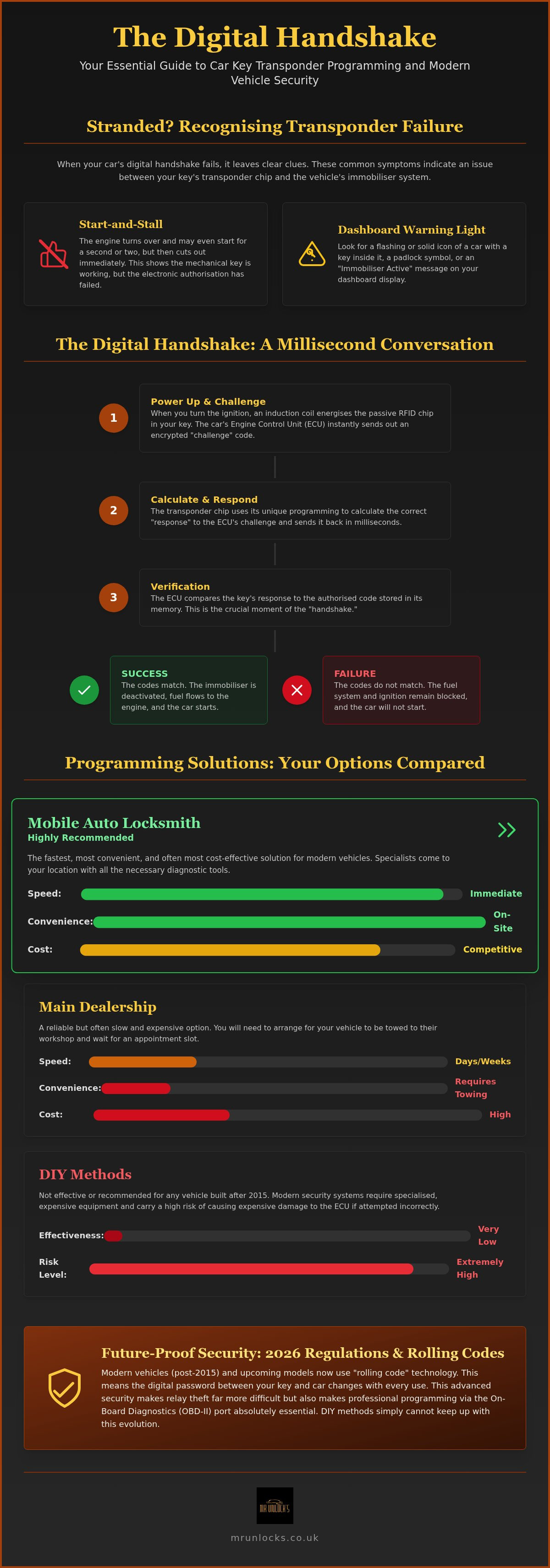
The Digital Handshake Process
The verification process is a high-speed sequence that completes before you even finish turning the key. First, the car sends a "challenge" signal. The key chip receives this and calculates a "response" based on its internal encryption. Finally, the ECU compares this response against its stored data. If the handshake fails, the engine may crank but will never fire. You will typically see a padlock icon on the dashboard or a "Key Not Recognised" message. Because the ECU controls the fuel injection and ignition timing, "hotwiring" is effectively impossible on modern UK vehicles. The hardware is physically locked out until the digital software says yes.
Diagnostic Programming vs. Key Cloning
It is vital to understand the difference between cloning and diagnostic programming. Cloning involves taking an existing, working key and copying its digital identity onto a new chip. Whilst this is a quick fix for a spare, it doesn't help if you have lost all your keys. Diagnostic programming is a much more robust solution. Instead of copying an old ID, the locksmith enters the car's system via the OBD port and grants a brand-new, unique ID to the vehicle's memory. This method allows the technician to delete any lost or stolen keys from the car’s database. It ensures that only the keys currently in your possession can start the engine, providing a higher level of security and peace of mind.
Programming Methods: DIY, Main Dealerships, or Mobile Locksmiths?
Choosing how to handle your car key transponder programming often depends on your budget and how quickly you need to be back on the road. Many drivers start with a quick search for DIY fixes, hoping to avoid a professional call-out. However, the "key cycling" sequences often found online rarely work for UK vehicles manufactured after 2015. These modern European models use secure gateway modules that require authorised server access to unlock. Attempting to use unverified programming tools bought cheaply from online marketplaces carries a massive risk. A single software glitch could "brick" your Engine Control Unit (ECU), turning a simple key issue into a mechanical catastrophe costing thousands of pounds.
Main dealerships are the most traditional choice, but they are rarely the most efficient. You'll usually face a waiting list of 7 to 10 days for a service slot. Because your car won't start, you must also pay for a recovery truck to tow the vehicle to their service centre. This adds a significant hidden cost to an already expensive invoice. Dealerships often charge a premium for the brand name, but the actual technical process is identical to what a specialist locksmith performs at your door. A mobile auto locksmith offers a proactive alternative, bringing dealership-level diagnostic equipment directly to your location in South East London or Kent.
The Reality of DIY Programming in the UK
Modern manufacturer security firewalls are designed to be impenetrable to basic tools. To bypass these, you need specialist software that communicates directly with the car's security logs. Whilst some older keys can be cloned using a simple handheld device, creating a fresh key for a lost-key situation requires a professional. Using "hacked" software found on unverified forums is a gamble with your vehicle's brain. One wrong command can permanently lock the immobiliser system, making the car impossible to start even with a genuine key later. Professional intervention ensures the software handshake is clean and authorised.
Comparing Costs and Convenience
When you compare the two, the difference is stark. A dealership takes days; a mobile specialist takes minutes. Choosing car key programming London services is often 50% cheaper than the rates quoted by main dealers. You save money on the labour rate and completely eliminate the recovery truck fees. We provide a transparent, immediate solution that keeps your vehicle secure and your schedule intact. There is no need to wait for a service desk to open or for a parts department to order a pre-coded key from a factory overseas. We cut and programme on-site, usually within an hour of arrival.
Common Symptoms of a Faulty Transponder and How to Diagnose Them
Check your dashboard immediately if your engine refuses to fire. The most obvious sign of a failure is the "Immobiliser Warning Light." This is typically a yellow or red icon shaped like a key or a padlock. If this light flashes rapidly or stays illuminated after you turn the ignition, your vehicle has failed to verify the key’s digital signature. In these cases, your car key transponder programming is the primary suspect for the lockout.
Another classic symptom is the "start-and-stall" behaviour. Your engine might roar to life for exactly one second before abruptly dying. This happens because the ECU allows a momentary ignition but cuts the fuel supply once the security handshake fails. Alternatively, the engine may simply crank indefinitely without ever igniting. This confirms that the gatekeeper has not authorised the start. If you are experiencing these frustrations in South East London or Kent, you should get an emergency car key diagnostic on-site to resolve the issue before you are permanently stranded.
Intermittent failures are equally common and often more frustrating. You might find the key works on the third or fourth attempt, only to fail again the next morning. This usually points to a loose chip inside the key casing or minor internal damage that prevents a clean signal. Don't ignore these early warning signs. A key that works "sometimes" will eventually stop working altogether, usually at the most inconvenient moment possible.
Is It the Battery or the Programming?
It is a common misconception that a dead fob battery prevents your car from starting. Most transponders are passive RFID chips. They draw power from the induction coil around the ignition, not from the internal battery. If your remote buttons don't unlock the doors but the car starts fine, you only need a battery. However, if the buttons work but the car won't start, the transponder programming is likely corrupted. Use this quick checklist to narrow down the fault:
Test the remote buttons for central locking response.
Try your spare key to see if the symptoms persist across both keys.
Watch the dashboard for flashing security icons during the cranking process.
What Causes a Transponder to "Lose" Its Code?
Physical trauma is the leading cause of chip failure. Dropping your keys on hard pavement can crack the delicate glass or carbon casing of the transponder chip. Whilst rare, strong electromagnetic interference can also de-synchronise older systems. In some instances, the fault lies within the vehicle itself. EEPROM corruption in the car’s security module can cause it to "forget" authorised keys. This internal software glitch requires professional tools to wipe the memory and perform fresh car key transponder programming to restore access and security.
Expert Mobile Car Key Programming Across London and Kent
Mr Unlocks operates as the specialist responder for drivers across South East London and Kent. We understand that a security lockout isn't just an inconvenience; it's an emergency that requires an immediate, professional solution. Our "Mobile Workshop" concept is designed to eliminate the stress of traditional repairs. Instead of you arranging a tow truck to a distant service centre, we bring dealership-level diagnostics directly to your roadside location. This approach saves you time, money, and the hassle of navigating dealership bureaucracy.
Our coverage spans the heart of Lewisham and Greenwich through to the busy outskirts of Bromley and Bexley. We also serve the wider Kent area, ensuring that no matter where you are stranded, help is never far away. If your situation involves keys locked inside the cabin, we guarantee non-destructive entry. We use specialised tools to gain access without causing a single scratch to your paintwork or window seals. Once inside, we can perform the necessary car key transponder programming on the spot to ensure your engine recognises the signal immediately.
Why South East London Drivers Choose Mr Unlocks
Reliability is our hallmark. We provide 24/7 emergency availability whilst many main dealerships and independent garages are closed for the evening. Our technicians possess the expertise to programme keys for all major makes, including Ford, VW, BMW, and Vauxhall. We don't just have the tools; we have the local knowledge. Our familiarity with the South East London and Kent road networks allows us to bypass traffic hotspots and reach you faster than a generic national service. We prioritise your safety and get you back behind the wheel with minimal delay.
How to Book an Emergency Programming Service
Booking our service is straightforward and designed for speed. When you call, please provide your vehicle's make, model, and year, along with your exact location in Kent or South East London. This information allows us to arrive with the correct blank keys and software protocols ready to go. Our process moves quickly from the initial diagnostic check to the final handover of your newly programmed key. To understand the timeframe better, you can read our guide on how long does car key programming take. If you need assistance right now, Contact Mr Unlocks for 24/7 Mobile Car Key Programming to speak with a technician immediately. We ensure your vehicle's car key transponder programming is handled with precision and care, restoring your mobility and peace of mind.
Secure Your Vehicle and Restore Your Mobility Today
Modern vehicle security is a digital barrier that requires expert intervention. You now understand that physical access is only half the battle. Without the correct digital handshake, your car remains immobile. DIY methods are increasingly obsolete for 2026 models, whilst dealership wait times can leave you stranded for over a week. Choosing a specialist response allows you to bypass the hidden costs of recovery trucks and long-term service centre delays.
Professional car key transponder programming ensures your immobiliser and key are perfectly synchronised on-site. Mr Unlocks provides a 24/7 mobile service across South East London and Kent. Our expert technicians handle all vehicle makes and guarantee non-destructive entry if you're locked out. Don't let a faulty chip or a lost key disrupt your schedule. Get a Fast Quote for Mobile Car Key Programming today. We're ready to act whenever you need us. You'll be back behind the wheel before you know it.
Frequently Asked Questions
Can I programme a car key transponder myself at home?
You cannot typically programme a modern car key transponder yourself because the process requires secure access to manufacturer-specific software. Whilst older vehicles occasionally featured "on-board" sequences, most cars built after 2015 use encrypted gateways that are impenetrable without professional diagnostic tools. Attempting a DIY fix with unverified hardware can lead to expensive ECU errors. It is safer to rely on a specialist who can guarantee a secure digital handshake.
How much does it typically cost to programme a car key in London?
The cost of car key transponder programming in London varies based on your vehicle's make, the key type, and the complexity of the security encryption. Premium brands or smart keys with rolling codes often require more advanced diagnostic time than standard transponder keys. Choosing a mobile locksmith is generally more cost-effective than a dealership because it eliminates the need for expensive vehicle recovery and avoids high manufacturer labour rates.
Will I need to tow my car to a garage for transponder programming?
You don't need to tow your car if you use a mobile auto locksmith service. We bring dealership-level diagnostic equipment directly to your location in South East London or Kent. This mobile approach is a significant advantage over main dealers who require the vehicle to be physically present in their workshop. Our on-site service removes the stress and additional expense of arranging a recovery truck for a non-starting vehicle.
What information do I need to provide a locksmith for key coding?
You should provide the locksmith with your vehicle's make, model, and year of registration to ensure they bring the correct transponder chip. It is also essential to have your Vehicle Identification Number (VIN) and proof of ownership ready for security verification. This data allows the technician to prepare the correct software protocols for your specific immobiliser system, ensuring the programming process is fast and accurate upon arrival.
Can a locksmith programme a key if I have lost all the original keys?
Yes, a professional locksmith can programme a new key even if you have lost all the originals. We use the OBD-II port to gain authorised access to the vehicle's security module and introduce a brand-new digital ID. During this process, we can also de-authorise any lost or stolen keys from the car's memory. This ensures that only the keys currently in your possession can start the engine.
How long does the transponder programming process actually take?
The transponder programming process usually takes between 30 and 60 minutes once the technician is at your vehicle. This includes the time needed to bypass the security firewall and synchronise the new chip with the ECU. Whilst some high-security European models may require a slightly longer connection to secure servers, the entire job is completed in a single visit. This is far more efficient than the long dealership waiting lists.
Is it possible to reprogramme a second-hand key from another vehicle?
Reprogramming a second-hand key from another vehicle is rarely possible for modern UK cars. Most transponder chips are "locked" to a specific VIN once they are paired for the first time. These chips are designed to be write-once for security reasons, meaning they cannot be wiped and reused on a different car. For a reliable result, we always recommend using a fresh, unprogrammed transponder chip for your vehicle.
Does my car key need a battery for the transponder to work?
Your car key does not require a battery for the transponder chip to function and start the engine. The transponder is a passive RFID device that is powered by the electromagnetic field generated by the ignition's induction coil. The battery inside your key fob is strictly for the remote central locking and alarm functions. This is why you can still drive your car even if the remote battery has completely failed.


Comments